
Blog

Pilates VS GYROTONIC®
I taught Pilates for years before becoming a licensed GYROTONIC® trainer. Here is how the two practices differ, where they meet, and how to know which one your body is asking for.
Before I became a licensed GYROTONIC® trainer, I spent years teaching Pilates, and the question I hear most from guests is still the same: what is the difference? The truth is, I love both. They come from different places, and they ask different things of the body.
Where they come from
Pilates was developed by Joseph Pilates in the early twentieth century. It is built on control, precision, and a strong center, and much of the repertoire moves the body along clear lines, forward and back, up and down, side to side, against spring resistance on the reformer or on the mat.
The GYROTONIC® method was created by Juliu Horvath, a former dancer, who drew from dance, yoga, swimming, gymnastics, and tai chi. Its movements are circular and spiraling, and the equipment is designed to follow the body through those arcs rather than guide it along a track.
Lines and spirals
This is the difference you feel first. Pilates often isolates a movement and refines it. In a GYROTONIC® session, the spine arches, curls, twists, and bends to the side in continuous sequences, often within a single movement. The joints travel through their full range in three dimensions, which is much closer to how we actually move when we reach, turn, or walk.
Stability and flow
Pilates is exceptional at building stability. You learn to keep your center steady while the arms and legs move. The GYROTONIC® method builds strength while the whole body is in motion, so you learn to be supported and fluid at the same time. Neither is better. They train different qualities.
Breath
Both practices take breath seriously. In Pilates, the breath supports the effort and helps stabilize the core. In the GYROTONIC® method, each pattern has its own breathing rhythm, and the breath helps drive the movement itself. That is where a session gets its flowing, almost meditative quality.
Which one is right for you
If you want to build a strong, stable center, or you are new to mindful movement, Pilates is a wonderful foundation. If you already have that foundation, or your body feels stiff, compressed, or stuck moving in straight lines, the GYROTONIC® method opens up range you may not have realized you were missing. Many of my guests find the two complement each other.
At Molding Movement, every private and duet session is GYROTONIC®, and my background in Pilates shapes how I teach. Sessions are available by appointment at our studio in Brickell.

Movement Reimagined
We are not two-dimensional, so our daily movement should not be either. A look at how the spiraling, continuous flow of the GYROTONIC® method moves the body the way it was designed to, and what that does for circulation.
We are not two-dimensional. We breathe in three dimensions. Our spines rotate, our hips and shoulders turn in spirals. And yet so much of how we move in a day happens along flat lines: forward to the desk, back to the car, up and down on a machine at the gym. Over time the body adapts to the shapes we ask of it. It gets very good at a few directions and quietly forgets the rest.
What drew me to the GYROTONIC® method was how it asks the body to move the way it was designed to, in arcs, spirals, and waves that rarely stop. That continuous, three-dimensional movement does something I feel in my own practice and see in my guests every week. It gets everything circulating.
Movement that keeps moving
Most exercise starts and stops. A GYROTONIC® sequence flows from one movement into the next, so the heart rate rises gradually and holds steady instead of spiking. Blood moves through the body without strain, and you can feel the warmth build from the inside.
Muscles that help the heart
As the spine arches, curls, and rotates, and the arms and legs reach out and return, the muscles lengthen and contract around the vessels in rhythm. That gentle squeeze supports venous return, the work of bringing blood back to the heart, and helps keep the lymphatic system moving, since lymph relies on movement to circulate.
Breath as part of the movement
Every pattern has its own breath. You are not holding it or forgetting about it. It moves with you. Full inhales open the rib cage in every direction, front, back, and sides, and full exhales let everything settle. It is calming and energizing at the same time, a combination most people do not expect.
Room in the joints
Because the movements spiral and decompress rather than compress, the joints get space and the surrounding tissue gets stimulated. The thing I hear most at the end of a session is some version of "I feel warm" or "I feel lighter." That is circulation doing its job.
Three-dimensional bodies, three-dimensional practice
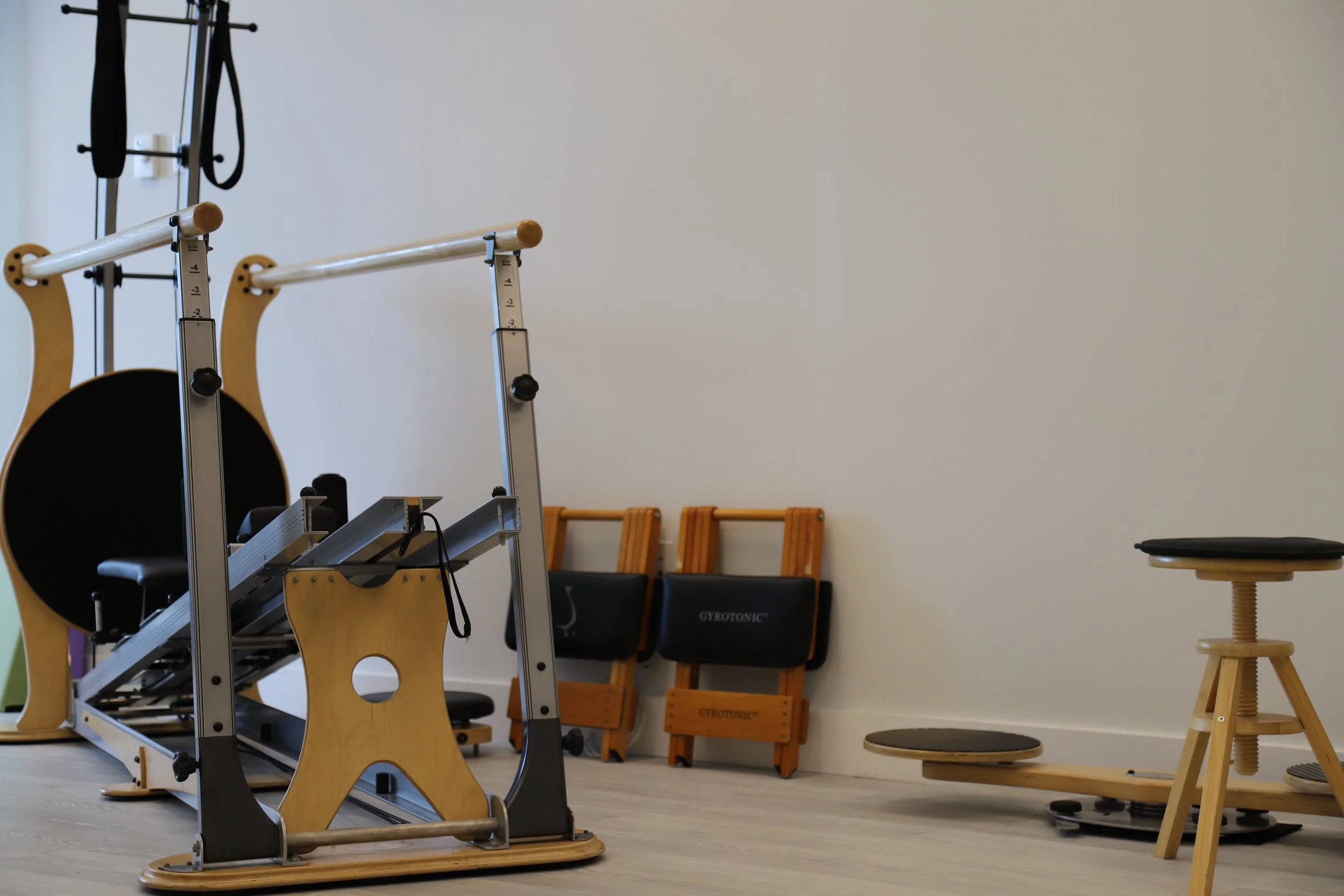
Every private and duet session at Molding Movement is built around the person in front of me. The Pulley Tower and Jump Stretch Board support the body as it moves through its full range, in every direction it was meant to go.
If you have been moving in straight lines for a while, your body will notice the difference. Sessions are available by appointment at our studio in Brickell.

Exploring GYROTONIC®
The best way to understand the GYROTONIC® method is to see it move. A short collection of videos from the official GYROTONIC® channel to help you explore the method before your first session.
The best way to understand the GYROTONIC® method is to see it move. Words like spiral, arch, and undulate only go so far. Watching the body travel through these continuous, three-dimensional patterns makes it click in a way a description cannot.
I gathered a few videos from the official GYROTONIC® channel to help you explore the method before your first session.
The method
Start here. This film introduces the GYROTONIC® method and the equipment behind it. Notice how each movement flows into the next, and how the spine moves in every direction rather than along a single line.
The full system
The GYROTONIC® method is one part of the GYROTONIC EXPANSION SYSTEM®, the larger body of work developed by Juliu Horvath. The system also includes the GYROKINESIS® method, practiced without equipment on a chair and mat. This video shows how the pieces fit together.
Movement quality
Juliu Horvath was a dancer before he developed the method, and dancers remain some of its most devoted practitioners. Even if you have never danced, watch for the quality of movement here: fluid, supported, and full.
Watching is a good start, but the method is meant to be felt. When you are ready to explore it for yourself, private and duet sessions are available by appointment at our studio in Brickell.
Videos courtesy of GYROTONIC® on YouTube. GYROTONIC®, GYROTONIC EXPANSION SYSTEM® and GYROKINESIS® are registered trademarks of Gyrotonic Sales Corp and are used with their permission.